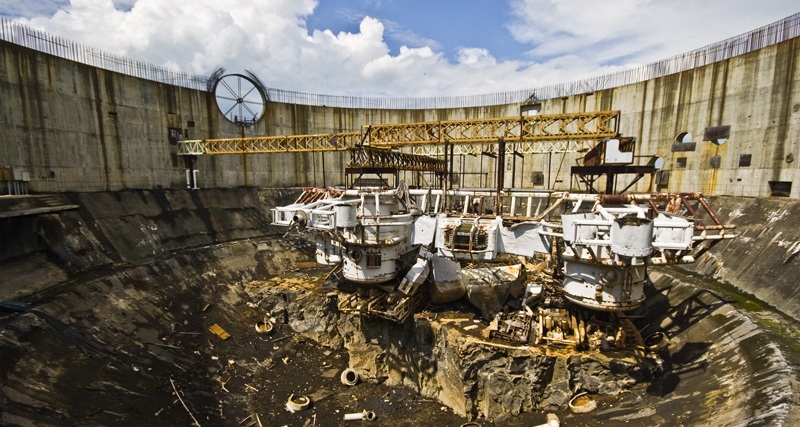
What’s amazing about James Cameron’s “The Abyss” is not its upcoming 20th anniversary and how it’s become the rare film to last throughout the years as an adventure extravaganza many audiences still treasure and remain in awe of decades later. Actually, what’s amazing about “The Abyss” is that, up to only a few years ago, the elaborate sets still remained in their original place for brave souls to view at the Cherokee Nuclear Power Plant in South Carolina.
Typically demolished or repurposed after filming ends, movie sets tend to live an extremely short life. They are the most disposable element of any production (after extras, of course), and while a few are deemed worthy enough to maintain after crews have moved on to bigger and brighter endeavors (the “Popeye” sets in Malta have been turned into a tourist trap), most are trashed and forgotten, left to live on the glory of celluloid and within the imagination of the viewer.
Perhaps at this point everyone who cares to know about the arduous, epic shoot for “The Abyss” has done the research, either by reading countless articles or viewing the extraordinarily candid documentary “Under Pressure,” found most recently on the 2-disc DVD release. It’s no secret the movie was an ambitious project that was a nightmare to shoot, solidifying Cameron as both a visionary and a tyrant.
Because of the massive effort that went into the crafting of “The Abyss,” I suppose it’s poetry to see that nobody took the time to properly tear down the sets contained within the vast open space of the abandoned containment vessel. The most entertaining aspect to all of this is how 20th Century Fox had no plans to return for a clean-up, only slapping some copyright stickers on the Deepcore set and various other screen highlights, shutting off the lights, and letting the structures disintegrate for nearly two decades.
Of course, had I known about this miracle earlier, I might’ve taken the time to travel out to South Carolina and visit the birthplace of what has remained my favorite film — a trip to a rusted, snake-infested cathedral, if you will. Criminally, I believe my opportunity has passed (reports show the site demolished a few years back), but a few lucky souls did make the effort to capture the sets over the years. Here are their amazing recollections:
Mike Prendergast found much to photograph in 1994.
Austin and Chris visited the site in 2003.


 BRIAN ORNDORF
Leave a comment